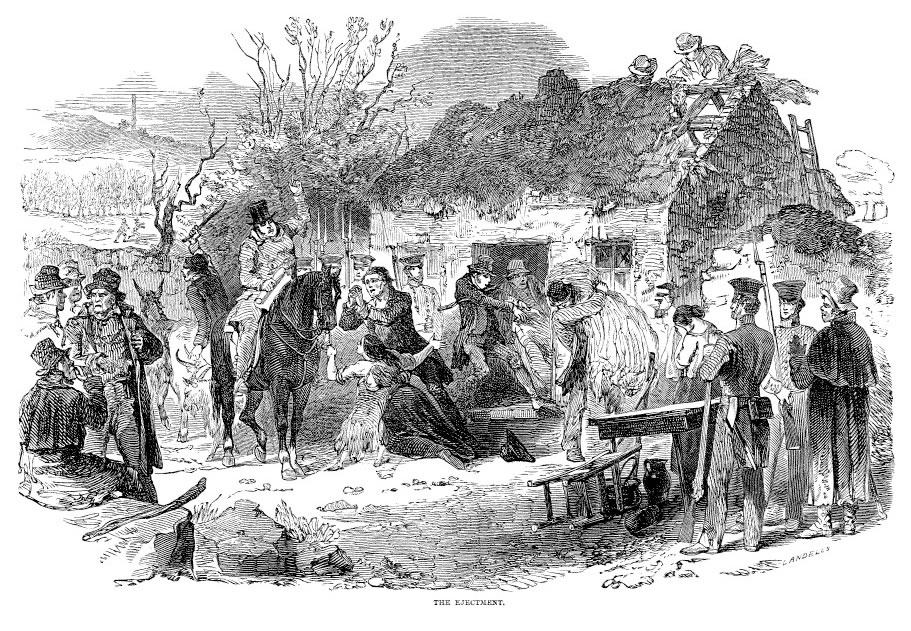
Whoever travels this country and observes the face of nature, or the faces and habits and dwellings of the natives, will hardly think himself in a land where law, religion or common humanity is expressed. The miserable dress and diet and dwelling of the people, the general desolation of most parts of the kingdom; the families living in filth and nastiness upon buttermilk and potatoes, without a single shoe or stocking to their feet, or a house so convenient as an English hog-sty to receive them. (Jonathan Swift, 1727)
The most detailed and evocative eye-witness accounts of the suffering of Irish famine emigrants in North America can be found in the annals of the Grey Nuns, or Sisters of Charity, who cared for them in the fever sheds of Montreal in 1847. (Irish Famine Archive)
“The judgment of God sent the calamity to teach the Irish a lesson. That calamity must not be too much mitigated. The greater evil with which we have to contend is not the physical evil of the famine, but the moral evil of the selfish, perverse and turbulent character of the Irish people.” (Charles Trevelyan to Parliament)
“The time will come when we shall know what the amount of mortality has been; and though you may groan, and try to keep the truth down, it shall be known, and the time will come when the public and the world will be able to estimate, at its proper value, your management of the affairs of Ireland.” (Lord Bentinck, in the House of Commons, 1847)
“The land in Ireland is infinitely more peopled than in England; and to give full effect to the natural resources of the country, a great part of the population should be swept from the soil.” (Thomas Malthus)
“A million and a half men, women and children were carefully, prudently and peacefully slain by the English Government. They died of hunger in the midst of abundance which their own hands created; and it is quite immaterial to distinguish those who perished in the agonies of famine itself from those who died of typhus fever, which in Ireland is always caused by famine...The Almighty, indeed, sent the potato blight, but the English created the Famine.” (John Mitchel in 1861)